Recording...
Spin Results
Caught in a loop weighing the same options? Type the choices that are tying you up, give the wheel a spin, and let physics — not anxiety — settle the matter.
Paste your list below, one item per line
Add your options, spin, and share the winner in seconds.
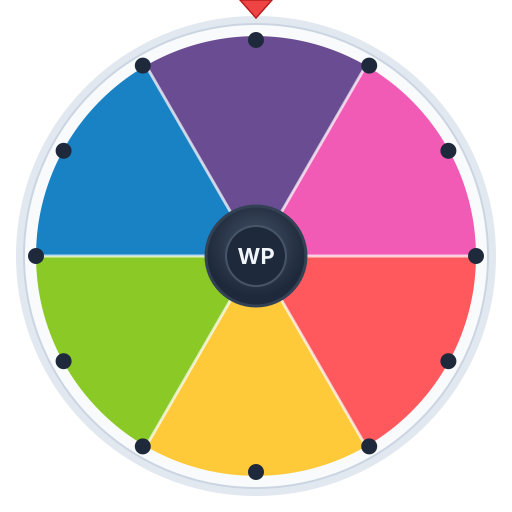
The Decision Wheel is a browser-based randomizer that takes a list of choices and assigns each one an equal slice on a spinning disc. You add the options, the wheel handles the picking, and an arrow points to whichever slice the algorithm lands on. There’s no math to do, no dice to find, and no coin to flip. The whole interaction takes about as long as reading this paragraph.
People reach for it when the stakes are low enough that thinking harder doesn’t help. Choosing a restaurant, picking a movie, deciding who unloads the dishwasher — these are the moments where the cost of deliberating is higher than the cost of being wrong. The wheel ends the loop fast and lets you move on with your evening.
Under the hood, the wheel uses cryptographically strong randomness so the odds are mathematically even across every option you enter. The animation is purely visual — the pick is made the instant you click SPIN.
A coin works fine when you have exactly two options and trust yourself not to throw best-of-three. The wheel scales further: three, five, or twenty choices all fit on one disc, and the odds stay even regardless of how many slices you add. It’s also harder to cheat. With a coin you can call do-overs in your head; with a wheel the slice is visible, the animation is recorded, and the result link is shareable, which makes the outcome binding when a group is watching.
Wheels also handle weighted choices better. If two of your three dinner options are sushi places, you can either de-duplicate them or accept that sushi has a higher chance of being picked — that’s often a feature, not a bug, because it mirrors how you actually rank the options.
If you specifically want a binary toss, our coin flip page exists for that, and the yes or no generator collapses the decision down to its simplest shape.
The first re-spin is honest: sometimes a result surprises you and reveals a preference. The fourth re-spin is a tell that the wheel is not deciding anything — you are, by rejecting the answers you dislike. A useful rule is a cap of two spins per question. If neither satisfies you, you have already learned what you want; pick that and treat the wheel as a diagnostic rather than an oracle.
Speed also matters more than people expect. Research on decision fatigue suggests that the longer you spend choosing between similar options, the less satisfied you are with the outcome. A two-second pick from a list of options you would all be happy with beats a two-minute internal debate, because the list was already filtered and the commitment is what locks in the result. A burrito is a burrito; the one you spent ten minutes choosing rarely tastes better.