Recording...
Spin Results
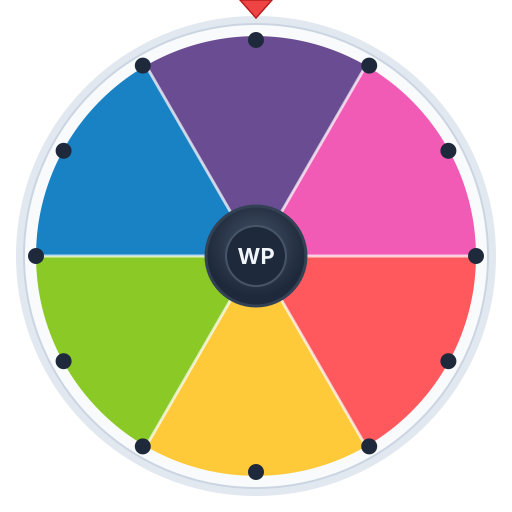
Roll a virtual die with one spin. The wheel starts as a standard six-sided die and can be edited into any polyhedral die from D4 to D100 — for board games, DnD sessions, and classroom maths when the real dice are lost under the sofa.
Paste your list below, one item per line
Add your options, spin, and share the winner in seconds.
Everyone has been three numbers short of an ability check because the dice bag is at home, or halfway through Monopoly when one die rolls under the fridge. This page is the backup. The wheel opens as a plain six-sided die, and turning it into anything else is a matter of pasting a list of numbers. No app to install, no account, and it runs on the phone that is already on the table.
It also solves a trust problem that physical dice create over video calls. When the roll happens on a shared screen, nobody has to take the word of the player whose webcam always freezes on a natural 20. The animation and the result are visible to everyone at once.
D4 covers daggers and darts. D6 is the workhorse: fireballs, hit dice, ability scores, and every board game on the shelf. D8 handles longswords and healing potions. D10 is heavy-weapon damage and the building block of percentile rolls. D12 is the greataxe and barbarian die. D20 is the heart of the d20 system: attacks, saves and skill checks all hinge on it.
To build any of them, paste the numbers 1 through N one per line. For a D100, do not build a hundred-slice wheel — roll the D10 twice and read tens then ones, treating a double zero as 100. It is exactly what the two-dice percentile set does at the table.
Most tabletop rolls are a die plus a modifier from your character sheet: 1d20 + 5 means spin the D20 wheel and add five. Advantage in 5e is two spins, take the higher; disadvantage takes the lower. Character creation with 4d6-drop-lowest is four spins of the six-sided wheel, discard the smallest, sum the other three, repeated six times.
Board games are simpler but still benefit from the spin count. Set it to two for Catan, Monopoly or Backgammon and the results panel adds the pair for you. For Yahtzee-style games, spin five times and re-spin only the dice you want to keep — the panel keeps every result in order so nobody loses track.
A projected dice wheel is a quiet favourite in maths lessons. Roll two dice twenty times and tally the totals; students see for themselves why seven comes up most often and twelve almost never. Roll one die a hundred times with the spin count and compare the tally to the expected 16.7 percent per face. Then duplicate a number so the die is deliberately loaded and let the class spot the bias from the data.
It also works as a random picker with a number twist: number the groups one to six and let the die pick who presents first. Because the wheel is big and visible on a whiteboard, students accept the result in a way they never accept a teacher “just choosing”.
Be honest about the limits. A wheel with more than about thirty slices becomes hard to read, so the D100 is best handled as two D10 rolls. If your game needs dozens of dice in a single roll (a Shadowrun pool of 14d6, say) the spin count will get you there but it is slow; a dedicated dice-pool app is the better tool. And if your table has real dice and everyone trusts them, use the real dice — the tactile clatter is part of the fun. Reach for the wheel when the dice are missing, the game is remote, or you want a big shared result that a whole room can watch.