Recording...
Spin Results
Pick a random number from 1 to 10 with one click. Spin the wheel for an animated pick, or hit Quick Pick for instant results.
Paste your list below, one item per line
Add your options, spin, and share the winner in seconds.
The numbers one through ten are the workhorses of everyday randomness. They settle who goes first in a board game, pick a lucky raffle slot in a small classroom, choose a question from a worksheet, or decide which of ten options to commit to. A random number from 1 to 10 is small enough to feel intuitive and large enough to feel fair, which is why it shows up in icebreakers, sports drills, drinking games, and parenting hacks all the time.
This page exists because most people typing random number 1 to 10 into a search bar just want one tap and one answer. The wheel is pre-loaded, the range is fixed, and the result is ready in under two seconds. No menus, no settings, no math homework.
Under the hood we call Math.random(), which returns a floating-point value in the half-open interval [0, 1). We multiply by ten and take the floor, then add one, giving us a uniformly distributed integer from 1 to 10 inclusive. Every number has a one-in-ten chance on every spin, independent of previous spins, just like a fair ten-sided die.
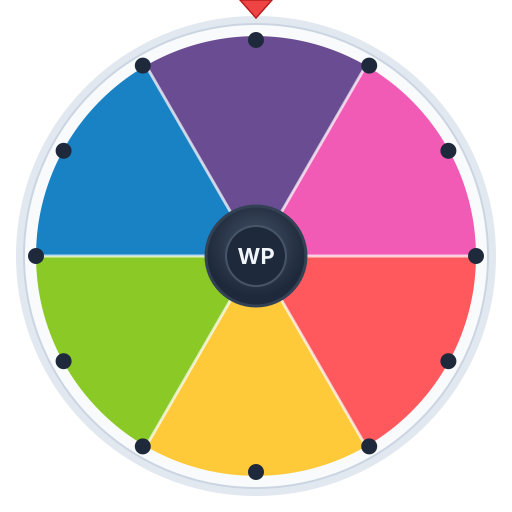
The spinning animation is purely visual. The winning number is decided first, then the wheel is rotated to land on the matching slice. That means you can leave the page mid-spin, come back, and the result will still be the same — the picture follows the math, not the other way around.
By default the wheel uses sampling with replacement: every spin is independent, and you can absolutely see 7, 7, 7 three times in a row. That is the correct model when you are simulating dice, choosing a number for a question prompt, or otherwise want each pick to be a fresh roll.
Switch to no-replacement mode and the wheel removes each drawn number from the next spin. After ten draws every number has appeared exactly once, in random order. This is the right mode for assigning ten people to ten tasks, ordering a ten-item playlist, or running a small raffle where each ticket can only win once.
Teachers use it for cold-calling: spin 1-10 to pick a row, then 1-10 again to pick a seat. Sports coaches use it to decide kick-off order, drill partners, or which cone to sprint to. Game nights use it as a poor-man's d10 when no one can find the dice bag. Parents use it for chore rotations, dessert picks, and the eternal who-gets-the-front-seat negotiation.
It also doubles as a quick decision tie-breaker between two people: each player picks a number 1-10 secretly, then spin — whoever is closer wins. The bounded range keeps the game fair and fast.
This is not a secure random number generator. Browser pseudo-randomness is fine for games and casual picks, but it should not be used to seed cryptographic keys, generate passwords, or produce numbers for anything where an adversary could benefit from predicting the next value. For those use cases your operating system or programming language offers a cryptographic RNG that draws from real entropy sources like hardware noise or timing jitter.
It is also not a replacement for an audited lottery draw. If you are picking lottery numbers to actually play, the official draw is the only one that matters — our wheel just produces a fun suggestion. And it is not a tool for predicting future events, divination, or fortune-telling; the outputs are mathematical, not mystical.
Finally, it is not stored, tracked, or analyzed. Every spin happens locally in your browser, and we keep no record of what numbers you draw or how many times you spin. Your randomness stays yours.