How Our Random Wheel Works
The Short Version
Every spin on WheelPickerApp is decided by your browser's cryptographically secure random number generator, every slice on the wheel has exactly the same chance of winning, and the result is fixed before the wheel starts to move. No server is involved, nothing you spun earlier affects the next spin, and your entries never leave your device. The rest of this page explains each of those claims and shows you how to check them yourself.
Where the Randomness Comes From
When you press Spin, the page asks the browser for a random value using crypto.getRandomValues. This is the same operating-system-backed random source that browsers use for encryption keys and session tokens. It is not a simple formula that a determined person could predict, and it is not seeded from the clock. The value comes back as a 32-bit integer, which the wheel converts to a number between 0 and 1 and then to an angle. Only on very old browsers that do not offer crypto.getRandomValues at all does the wheel fall back to the older Math.random function; every current version of Chrome, Safari, Firefox and Edge, on desktop and mobile, uses the secure source.
Every Slice Has Equal Odds
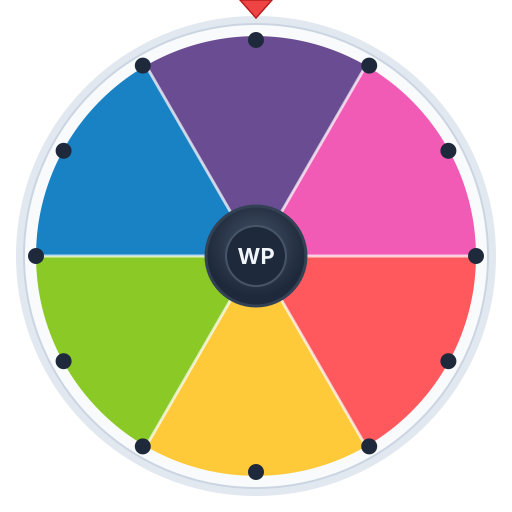
The wheel divides its full circle evenly between the entries in your list. Ten entries means ten slices of 36 degrees each; twenty-five entries means twenty-five slices of 14.4 degrees each. Because the landing angle is drawn uniformly from the whole circle, each slice has precisely one-in-N odds, where N is the number of entries. There is no hidden weighting and no favoured position. If you want an entry to be more likely, the only way is the visible one: add it to the list more than once, so it occupies more slices. The Percentages display shows the resulting odds for every slice so everyone watching can see them.
The Result Is Decided Before the Animation
The spinning wheel is a visualisation, not the mechanism. In the instant you press Spin, the random angle is chosen and the winning slice is already known to the page. The animation then rotates the wheel through several full turns and eases to a stop exactly on that angle. The deceleration, the ticking sound, the near-misses as the pointer slows past the last few slices: all of that is drawn after the fact to make the reveal enjoyable. Nothing during the animation can change the outcome, and there is no moment where the wheel is "still deciding".
No Server, No History, No Influence
WheelPickerApp is a static site. There is no backend, no database and no account system, so there is no place where a result could be stored, adjusted or steered. The random number is generated on your device and used on your device. Each spin is independent of every spin before it: the page does not track which slices have won, does not try to "balance" outcomes, and does not have a hot or cold streak. If a two-entry wheel lands on the same side four times in a row, that is simply what independent one-in-two events sometimes do, and the fifth spin is still exactly fifty-fifty.
Elimination Mode
The one deliberate exception to "each spin is independent" is Eliminate mode, and it is under your control. With it switched on, the winning entry is removed from the wheel after each spin, so the remaining entries share the circle equally on the next spin. This is what you want for drawing several giveaway winners without repeats, for classroom turn-taking, or for working through a list until it is empty. Switch it off and the wheel returns to full independence, with every entry in play on every spin.
How to Verify It Yourself
You do not have to take our word for it. Put two entries on the wheel, A and B, and spin it a hundred times, tallying the results on paper. You should see something close to fifty each; anything between roughly forty and sixty for either side is normal for a hundred trials. Repeat with ten entries and two hundred spins and each should land around twenty times. If you are comfortable with a browser's developer console, you can also read the source: the spin outcome is produced by a small function that calls crypto.getRandomValues, and it is loaded in the page's JavaScript bundle for anyone to inspect.
Why This Matters for Giveaways and Classrooms
For a giveaway host, a fair draw is what protects you from the accusation that you picked a friend. Because the result is decided by a secure random source, is identical in odds for every entrant, and can be recorded with Record & Spin from the full list through to the landing, you can show your audience the draw rather than ask them to trust it. For a teacher, the same properties mean cold-calling and reward spins are demonstrably fair to every student in the room, and the "the wheel chose" answer ends arguments before they start. For anyone using the wheel to settle a decision, it means the answer is honest chance and not a nudge.
Common Questions
Does the spin speed or how long I hold the button matter? No. The button is a single trigger; pressing harder, tapping twice or waiting between spins changes nothing, because the angle is drawn from the secure source and not from timing.
Can a bigger or brighter slice attract the pointer? No. Colours, emojis and label length are cosmetic. Odds depend solely on how many slices an entry occupies.
Why did the pointer stop on a boundary? It did not; the drawn angle always falls strictly inside one slice, and the highlighted winner is the authoritative reading even if the graphic looks tight on a small screen.
Is the number wheel or the dice roller different? They share the same generator. A dice face, a coin side, a letter or a number is just a slice with a different label.
Could a browser extension or ad script tamper with the result? The generator runs inside the page's own code and takes its value from the operating system. We cannot rule out malicious software on a compromised computer, but the site itself offers no hook for it.
Privacy
Your entries never leave your device. The list you type or paste is held in your browser's local storage so it survives a reload, and the share link encodes it into the URL itself rather than saving it anywhere. There is no upload, no account, no form and no server to send it to. Recordings made with Record & Spin are rendered in your browser and downloaded straight to your device. Clear the list, or clear your browser data, and it is gone. Our privacy policy has the full details, and the about page describes how the site is built.